
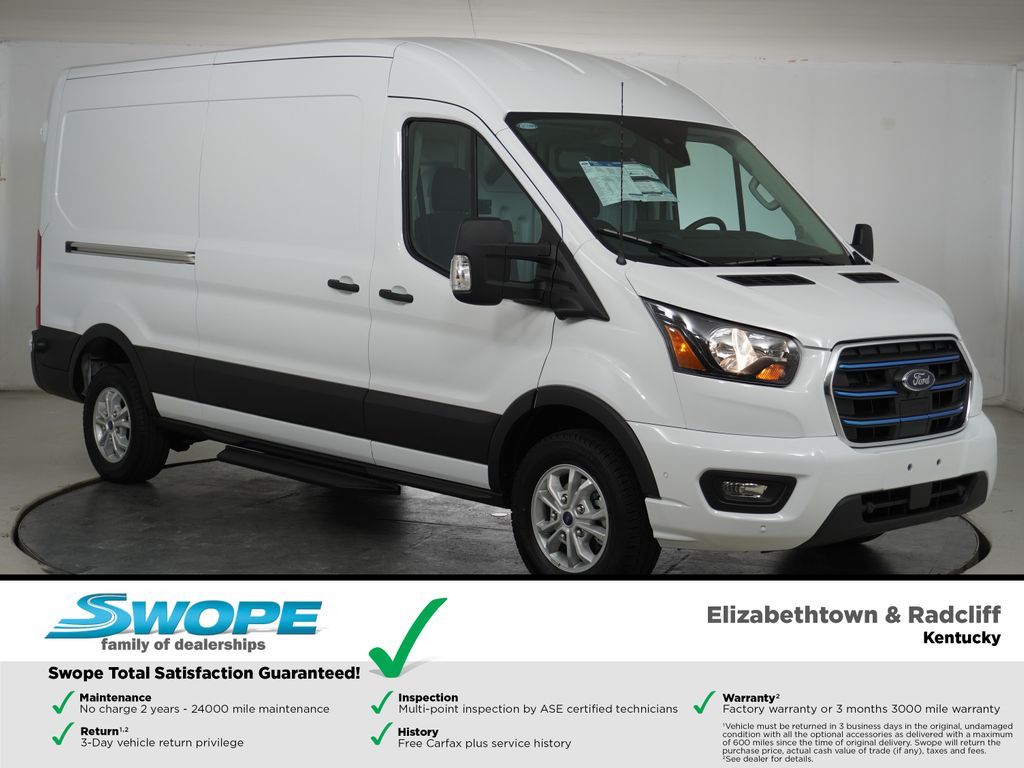
2023 Ford E Transit: What's in stock, trim-level comparison, FAQ's.

    Updated 2026-09-27
    Quick Answer

    The 2023 Ford E-Transit is the all-electric version of the full-size Transit, sold as a two-seat cargo van in eight configurations across three roof heights and three lengths, plus chassis cab and cutaway models. Every version pairs a 68 kWh usable battery with a single rear motor making 266 horsepower and 317 lb-ft through a single-speed transmission, RWD only. Ford estimates up to 126 miles of range for low-roof vans, with payload up to 3,880 lbs and cargo volume up to 487.3 cu ft. Ford Co-Pilot360 driver assists, including automatic emergency braking and lane keeping, are standard. Bob Swope Ford has 1 Base available right now.

    Highlights of the 2023 Ford E Transit

    7 highlights
    • 266 horsepower and 317 lb-ft from a single rear-mounted motor, with the same 68 kWh usable battery in every 2023 configuration
    • Ford-estimated range of 126 miles for low-roof vans, 116 miles for medium roof, and 108 miles for high-roof bodies
    • Up to 3,880 lbs of payload in the cargo van and up to 487.3 cu ft of cargo volume, identical interior space to the gas Transit
    • DC fast charging at up to 115 kW takes the battery from 15 to 80 percent in about 34 minutes
    • Available Pro Power Onboard supplies up to 2.4 kW of AC power for tools and equipment from the traction battery
    • 8-year/100,000-mile warranty on the high-voltage battery and electric drive components
    • Standard 12-inch SYNC 4 touchscreen and standard Ford Co-Pilot360 safety features

    Trim-Level Comparison and Availability at Bob Swope Ford

    Compare available trim levels to find the right Ford E Transit for you. Pricing reflects current in-stock inventory.

    Compare trimsTrim1 trim · 1 in stockBase1 in stock
    Pricing
    Starting price$40,371
    Top price$40,371
    Powertrain
    DrivetrainRWD
    Fuel optionsElectric
    EngineElectric Motor
    Standard equipment · Safety & driver assistance
    Ford Co-Pilot360
    Standard equipment · Technology & infotainment
    Built-in navigation
    In-vehicle Wi-Fi hotspot
    Push-button start with proximity key
    SYNC 4 infotainment
    Standard equipment · Interior & exterior
    Front fog lamps
    Side step / running boards

    Inside the Ford E Transit

    How range and payload change by configuration

    Every 2023 E-Transit pairs the same 68 kWh usable battery with a single rear-mounted motor rated at 266 horsepower and 317 lb-ft, driving the rear wheels through a single-speed transmission. What changes with configuration is range and payload. Ford estimates 126 miles for low-roof vans, 116 miles for the medium roof, and 108 miles for high-roof bodies, because taller vans add weight and drag. Payload runs up to 3,880 lbs in the cargo van and up to 4,428 lbs for cutaway versions, decreasing as the body gets longer and taller. Because the E-Transit's GVWR of 9,500 lbs puts it above the 8,500-pound EPA labeling threshold, it does not appear on fueleconomy.gov; the range figures are Ford estimates using EPA-style methodology. One more caution: 2023 offered a single battery. The larger Extended Range pack did not arrive until the refreshed 2024 model.

    Matching the configuration to the job

    Ford built the 2023 E-Transit for depot-based duty cycles, citing data that the average US commercial van covers about 74 miles a day, well inside the low-roof van's 126-mile estimate. Last-mile parcel and urban service routes suit the low or medium roof, which preserve the most range. Trades that need standing room or tall shelving should take the high roof and plan around 108 miles. Because the battery sits under the floor, existing Transit racks, bins, and partitions carry over unchanged, and chassis cab and cutaway versions accept box bodies and specialty upfits. The optional 2.4 kW Pro Power Onboard system runs saws, chargers, and lights from the traction battery, replacing a separate generator on many job sites. Plan charging around the 11.3 kW onboard AC charger, which refills the battery overnight at a depot, with 115 kW DC fast charging as a midday backstop.

    How it compares with the gas Transit

    The gas 2023 Transit offers a 275-horsepower 3.5L V6 or a 310-horsepower EcoBoost V6, a 10-speed automatic, optional AWD, and tow ratings up to 6,800 lbs. The E-Transit is RWD only, carries no factory tow rating, and trades unlimited refueling for a 108-126 mile working radius. Cargo volume is identical, up to 487.3 cu ft, because the battery lives under the floor, though the gas van holds a payload edge in like configurations since it weighs less. The E-Transit answers back on running costs: electricity per mile typically undercuts gasoline, there are no oil changes, and regenerative braking stretches brake service intervals. It is also quieter and smoother in stop-and-go work. The decision usually reduces to route math: predictable sub-100-mile daily routes that return to a depot favor the EV, while long trips, towing, or AWD needs still point to the gas van.

    Pros and Cons

    Pros
    • Same cargo dimensions and upfit compatibility as the gas Transit, up to 487.3 cu ft in the high-roof extended-length body
    • Quiet, smooth power delivery with 317 lb-ft of instant torque, well suited to stop-and-go urban routes
    • Lower scheduled maintenance than a gas van: no oil changes, and regenerative braking reduces brake wear
    • 115 kW DC fast charging restores 15 to 80 percent of charge in about 34 minutes, roughly a lunch break
    • Available 2.4 kW Pro Power Onboard powers tools directly from the traction battery, no separate generator needed
    • 8-year/100,000-mile electric component warranty on top of standard 3-year/36,000-mile bumper-to-bumper coverage
    • Wide configuration spread: eight cargo van bodies plus chassis cab and cutaway, all at 9,500 lbs GVWR
    Cons
    • Short range: 108 to 126 miles Ford-estimated depending on roof height, and cold weather cuts it further, with some owners reporting around 80 miles in winter
    • No factory tow rating for 2023, while the gas Transit tows up to 6,800 lbs
    • RWD only; the gas Transit offers optional AWD for winter climates
    • Costs thousands more up front than a comparable gas Transit, with a 2023 base price around $53,790 before the $1,895 destination charge
    • Only one battery size for 2023; the roughly 89 kWh Extended Range pack was not offered until the 2024 refresh, so longer routes have no factory fix in this model year

    New 2023 Ford E Transit Inventory at Bob Swope FordLive

    Current in-stock units at Bob Swope Ford in Elizabethtown, KY with full specifications, pricing, and direct links to each vehicle's detail page.

    Total in stock1vehicle
    Price range$40,371
    Available powertrainsElectric
    Last syncedSep 27, 2026 · 9:50 AM
    Showing 1 of 1 vehicles.
    VINStock #YearMakeModelTrimBodyPriceVDPMileageExteriorInteriorEngineDriveTransmissionFuelNew/UsedCPOCarfax AccidentCarfax 1-OwnerDoorsOptions
    1FTBW9CKXPKB58790F238010202023FordE-TransitBaseMedium Roof Van$40,371VDP151Oxford WhiteEbonyElectric MotorRWDAutomaticElectricNewNoNoNo3
    89 features
    Interior Upgrade Package: Short-Arm Manual-Folding Power Adjustment MirrorsIlluminated Sun VisorsCruise Control with Adjustable Speed Limiting Device (ASLD)Order Code 101A: Single-Speed Transmission

    Frequently Asked Questions about the 2023 Ford E Transit

    The 2023 Ford E-Transit carries a Ford-estimated range of 126 miles with the low roof, 116 miles with the medium roof, and 108 miles with the high roof, all from the same 68 kWh usable battery. These are Ford's own estimates using EPA-style methodology, since vans over 8,500 lbs GVWR are not listed on fueleconomy.gov. Real-world range drops with heavy payloads, highway speeds, and cold weather, so plan routes with a buffer.
    On DC fast charging at up to 115 kW, the 2023 E-Transit goes from 15 to 80 percent in about 34 minutes. On AC power, the standard 11.3 kW onboard charger refills the 68 kWh battery overnight on a 240-volt Level 2 depot or garage charger, which is how most fleets run it: charge overnight, work all day.
    The 2023 E-Transit cargo van is rated for up to 3,880 lbs of payload, with cutaway versions rated up to 4,428 lbs; payload decreases as the body gets longer and taller. Cargo volume is identical to the gas Transit because the battery sits under the floor, topping out at 487.3 cu ft in the high-roof extended-length van.
    Ford published no tow rating for the 2023 E-Transit, so it should be treated as a payload-only vehicle. The van was engineered around cargo carrying, and towing would also cut sharply into its 108-126 mile range. If trailering is part of the job, the gas 2023 Transit is rated to tow up to 6,800 lbs.
    The 2023 E-Transit comes as a two-seat cargo van in eight combinations of three roof heights (low, medium, high) and three lengths (regular, long, extended), plus chassis cab and cutaway models for box bodies and specialty upfits. All are Transit 350 series vehicles with a 9,500-pound GVWR, a single 68 kWh battery, and RWD.
    The 2023 E-Transit's high-voltage battery and electric drive components are covered for 8 years or 100,000 miles, whichever comes first. That sits on top of the standard 3-year/36,000-mile bumper-to-bumper warranty, 5-year/60,000-mile powertrain coverage, and 5-year unlimited-mile corrosion coverage.
    The 2023 E-Transit is a light carryover of the 2022 launch model: same 68 kWh battery, 266-horsepower motor, range estimates, and body lineup. Updates were minor, including a standard reverse speed limiter, new paint choices, and newly optional items such as rear proximity sensors and a backup alarm. The bigger Extended Range battery and higher-output motor did not arrive until the 2024 refresh.
    Usually yes, once it is on the road. Electricity per mile typically costs less than gasoline, especially on overnight depot rates, and the E-Transit skips oil changes while regenerative braking extends brake life. The tradeoff is up front: the 2023 E-Transit started around $53,790 before destination, thousands more than a comparable gas Transit, so the savings case depends on daily mileage and local electricity rates.